Every hardwood spec discussion in Houston starts with the same question — engineered or solid? — and ends with the same problem: the homeowner saw a magazine spread, the designer wants the look, the builder is on a timeline, and nobody at the table is talking about relative humidity.
Get this decision right and the floor will outlive the kitchen, the windows, and probably the roof. Get it wrong and you'll be back inside of three years with cupping, gapping, crowning, or worse. This guide is for the designers, architects, and builders who specify hardwood for a living and want a clear answer for Houston projects.
The Houston humidity problem in plain numbers
Wood is hygroscopic — it absorbs and releases moisture from the air, expanding and contracting as it goes. The accepted "stable zone" for solid hardwood is 30–55% relative humidity. Below 30%, wood gives up moisture and shrinks (gaps appear between boards). Above 55%, wood absorbs moisture and swells (cupping, crowning, edge crushing).
Now look at what Houston actually does:
- Average annual outdoor humidity: 74.6% (NOAA Houston Hobby, 30-year normal).
- Summer peaks: 90–95% from June through September.
- Winter lows: rarely below 50% outdoor, even in a dry cold front.
- Indoor humidity in a typical Houston home with HVAC running normally: 55–70%.
- Indoor humidity in a Houston home during a power outage or unoccupied (vacation home, listed property): can climb to 80%+ within 48 hours.
That last number is what kills solid hardwood in Houston. Most of the floor failures we get called to look at started with a 4-day stretch where the house was empty, the AC was off, and the wood absorbed enough moisture to cup permanently.
What the two product categories actually are
Solid hardwood (a.k.a. ¾" solid)
One piece of wood, top to bottom — typically ¾" thick, tongue-and-groove milled, in widths from 2¼" up to 10". Because the grain runs in one direction, the entire board expands and contracts as a unit. Wide planks (7"+) move more than narrow ones because the math is linear: a 6" wide-plank board that expands 1% gains 1/16" of width. Five of those side by side and you've gained 5/16" across 30 inches — enough to cup or crown.
Solid hardwood is gorgeous, refinishable 5–8 times over its life, and the historically correct spec for restoration work. It also tells you exactly what wood is — every imperfection, every knot, every variation is real and runs through the board.
Engineered hardwood
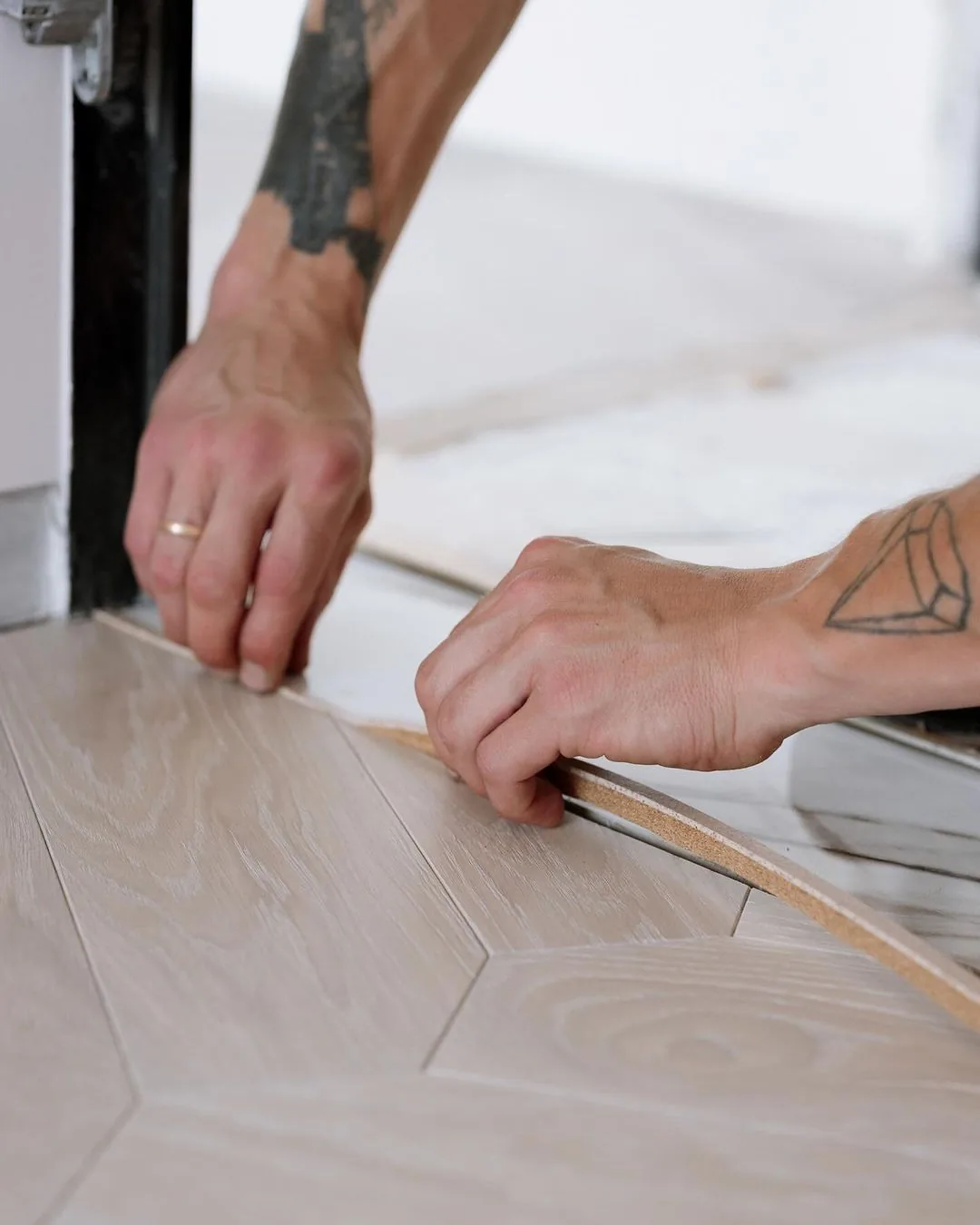
A laminated sandwich. A wear-layer veneer of real hardwood (anywhere from 1 mm cheap to 6+ mm premium) bonded over a cross-laminated core of plywood, HDF, or in the best products, additional plies of hardwood. The cross-grain core is the magic: because the layers oppose each other's expansion, the whole assembly is 4–10x more dimensionally stable than solid hardwood.
Engineered is what most premium European mills (the ones we source from in Spain, France, and Italy) actually produce. They're not making engineered as a budget alternative — they're making engineered because the European designer market wants 8" and 10" wide planks, and solid in those widths cannot hold up to even European climate, let alone Houston's.
Direct head-to-head: which wins in Houston?
The honest answer is: engineered wins in 8 out of 10 Houston specs. Here's the breakdown.
When solid wins
- Historic restoration in River Oaks, Heights, Montrose, or West U. If the home is pre-1960 and on a pier-and-beam foundation with a wood subfloor, solid 2¼" or 3¼" red oak is the historically-correct spec and the structure can handle it.
- Whole-home owner who runs HVAC year-round. If your client lives in the house, keeps it at 70°F and 45% RH constantly, never leaves it unconditioned for more than a long weekend, and accepts that solid wood will move seasonally — solid hardwood will give them an heirloom floor.
- Pier-and-beam construction with a properly insulated crawl space. Wood subfloor, ventilated crawl, vapor barrier — this is what solid hardwood was designed for.
- Refinishability across 80+ year horizons. Solid can be refinished 5–8 times. The grain runs all the way through, so a deep sand still hits fresh wood. A premium engineered with a 6 mm wear layer can refinish 3–4 times; lower wear layers can't be refinished at all.
When engineered wins
- Slab-on-grade construction. The vast majority of homes built in Houston after 1980 sit on a slab. Concrete passes moisture vapor constantly — even with a vapor barrier under the slab, you're looking at 3–5 lbs per 1,000 sf per day of moisture migration. Solid hardwood cannot be installed over slab in Houston. Period. Engineered with a glue-down or floating method handles this.
- Wide planks (7"+). If your client or design calls for 7", 8", 9", or 10" wide planks — engineered is the only correct spec for Houston. Solid in those widths will cup within one summer.
- Radiant heat over slab. Rare in Houston but it happens in River Oaks new builds and Memorial customs. Only engineered handles thermal cycling without separating.
- Vacation homes, listed properties, second homes. Any home that won't be continuously climate-controlled. Engineered tolerates 3–5x more humidity swing than solid before failing.
- Multi-family, townhomes, condos. HOA acoustic requirements often demand floating installations over sound mat — only engineered works floating.
- Tight construction timelines. Engineered acclimates in 7 days; solid needs 14. On a builder's critical path, that week matters.
The decision matrix
If you want a clean spec rule to give to a junior designer or a project manager, this is it:
| Project characteristic | Spec |
|---|---|
| Slab-on-grade subfloor | Engineered — always |
| Pier-and-beam subfloor + climate-controlled | Solid acceptable, engineered fine |
| Wide plank (7"+) requested | Engineered — always |
| Narrow plank (≤ 5"), pier-and-beam, year-round HVAC | Solid acceptable |
| Radiant heat or sound mat required | Engineered — always |
| Owner travels often, home unoccupied 30+ days/yr | Engineered |
| Spec home or listed-for-sale property | Engineered (no humidity control during sale) |
| Historic restoration, designer-led, owner-occupied | Solid (period-correct) |
| Multi-family / townhouse / condo | Engineered (floating typical) |
| Commercial / retail / office | Engineered with commercial wear layer |
Acclimation: the step nobody wants to do but everyone needs to
Acclimation is the single most-skipped step in Houston hardwood installs, and it causes more callbacks than wood species, finish, or installer skill combined. The rule:
- Engineered: 7 days minimum on-site, boxes opened and cross-stacked in the room of installation, HVAC operating at occupied conditions, moisture meter readings of subfloor and flooring within 2–4%.
- Solid: 14 days, same conditions.
If a builder tells you their crew can install hardwood the day it's delivered, walk away. We've seen $40,000 floors fail at month four because the install date was driven by the construction schedule and not the moisture readings.
Wear layer math: how long will the floor actually last?
Engineered hardwood lifespan is governed by wear-layer thickness, which determines refinishability:
- 1–2 mm wear (cheap engineered): Cannot be refinished. Lifespan 15–25 years. Avoid for any premium spec.
- 3 mm wear (mid-tier): 1 refinish possible, very light. 25–40 years.
- 4 mm wear (premium): 2 refinishes. 40–60 years. This is the sweet spot for residential.
- 6 mm wear (top-tier European): 3–4 refinishes. 60–80+ years. Comparable to solid hardwood lifespan with all the climate advantages.
If a manufacturer won't publish the wear layer thickness in mm, don't spec it.
How we spec for Houston projects at Jamail
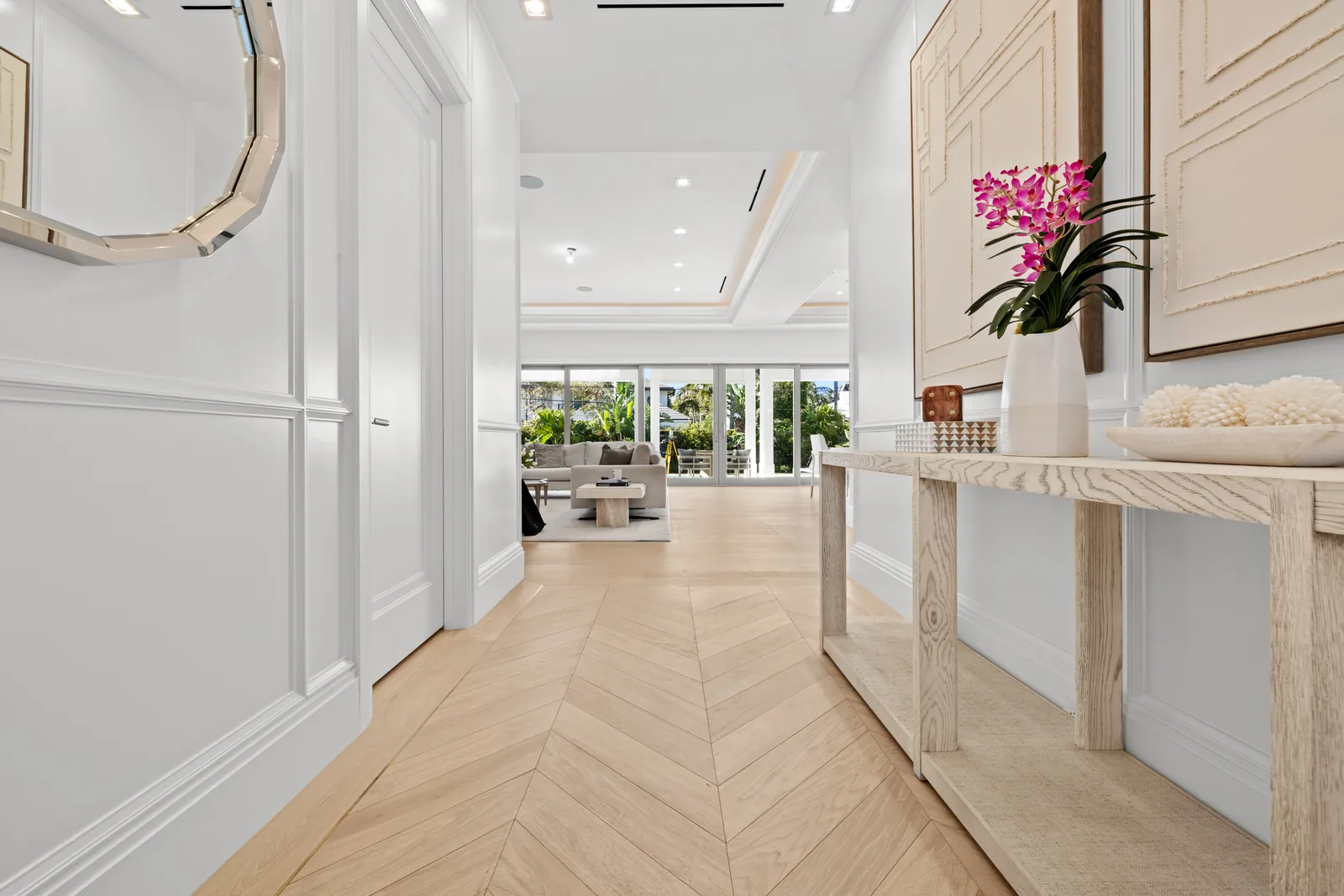
Our default Houston recommendation across designer, builder, and architect work is European white oak engineered with a 4–6 mm wear layer, multi-ply HDF or birch-plywood core, factory finished with low-VOC matte oil or hardwax oil. Wide planks (7"–10") for designer-driven projects; narrower planks (5"–7") for spec homes and value builds.
For pier-and-beam restorations in the Heights or West U, we'll spec solid 3¼" or 4" white oak or American walnut with site-finishing for the historically-correct look and feel — but only when the home is consistently occupied and conditioned.
If you'd like a sample kit with both engineered and solid options for an upcoming project, our designer and architect programs include free presentation kits delivered to your studio.
Spec'ing hardwood for a Houston project?
Get a free sample kit for your studio, or book a job-site walkthrough with a rep.
Book a Trade Consult Browse Spec Library