For Builders & Architects · Climate Spec
Houston Humidity and Hardwood Spec — What Every Trade Pro Needs to Know
Houston's 50-80% summer RH and 35-45% winter RH define what hardwood spec works here and what fails. A climate-aware spec sheet for builders, architects, and designers.
Why this matters
Houston is one of the toughest hardwood install climates in North America. Summer humidity routinely runs 70-80% with daytime dewpoints in the high 70s; winter humidity drops to 35-45% with HVAC dehumidification on. That seasonal swing — combined with post-tension slab construction, slow-curing concrete, and the long Gulf Coast humidity season — kills hardwood installs that aren't spec'd for the climate.
The good news: there's a well-documented spec profile that holds up over 25+ years in Houston. The bad news: most generic hardwood guidance is written for the Northeast or West Coast climate. If you spec a Houston project off a generic spec sheet, you're going to have a failed floor by year 3.
The Houston humidity profile, month by month
To spec correctly, you need to internalize the seasonal pattern. Houston's outdoor RH and corresponding indoor RH (with HVAC running) typically tracks:
- March-May: Outdoor 65-80% RH; indoor 50-60% with HVAC. Acclimation-friendly.
- June-September: Outdoor 75-85% RH; indoor 50-65% with dehumidification. Highest stress on hardwood — moisture wants to migrate into the wood.
- October-November: Outdoor 60-75% RH; indoor 45-55%. Transition; moisture stress declines.
- December-February: Outdoor 50-65% RH; indoor 35-45% with heating on. Lowest moisture content; hardwood contracts.
The dimensional swing for solid 3/4" oak over a year in Houston is roughly 0.15-0.25" per 4" wide board. Multiply that across a 5,000 sq ft floor and you get hairline gaps in winter, cupping in summer, and progressive failure year over year.
The dimensional swing for engineered European oak with cross-grain plywood core is roughly 0.01-0.04" per 4" wide board — about 10% of the solid hardwood swing. That's why engineered is the only viable spec for slab installs in Houston.
HVAC target — 35-55% RH year-round
The single most controllable variable on a Houston install is the indoor humidity target. Set the HVAC and whole-home dehumidification system to maintain 35-55% relative humidity year-round, and the hardwood install will perform.
For Houston custom homes, that typically means:
- Multi-zone HVAC with humidity control on each zone
- Whole-home dehumidifier on the main air handler (Aprilaire, Honeywell, Ultra-Aire are common)
- Humidity sensors in 2-3 locations to verify reading accuracy
- HVAC running and balanced for 14+ days before hardwood delivery
We require HVAC documentation (typically a photo of the thermostat showing humidity reading and a confirmation from the HVAC contractor that the system is online and balanced) before delivering hardwood to a Houston jobsite. Material gets held at our Houston warehouse otherwise — at no storage fee — until HVAC is confirmed.
This isn't a sales position. It's a warranty position. Moisture damage during construction is not a manufacturer-covered failure. We'd rather delay delivery a week than have a builder file a warranty claim in year 2.
Slab moisture — the variable that decides install success
New post-tension slabs in Houston release moisture for 6-18 months after pour. The moisture content of the slab when you install hardwood determines whether the install succeeds.
Industry-standard test protocols:
- ASTM F1869 (calcium chloride test): Maximum 4 lb of moisture emission per 1,000 sq ft per 24 hours for most engineered hardwood manufacturers. Some accept up to 5 lb with moisture mitigation.
- ASTM F2170 (in-situ RH probe): Maximum 75% RH at the probe depth (typically 40% of slab thickness). Some manufacturers accept up to 80% with mitigation membrane.
Both tests are run by the install crew at the time of delivery. Results documented in the project file. If the slab exceeds threshold, install is delayed until either the slab dries further (sometimes weeks) or a moisture-mitigation membrane is applied (Mapei P-1, Bostik MVP4 are common).
On Houston builds, our default is to apply moisture-mitigation membrane regardless of test result. Belt and suspenders. The cost is roughly $0.50-0.80 per sq ft material; install adds ~$0.20. Cheap insurance against a $30,000+ floor replacement.
Acclimation period — don't compress this
Acclimation is the period during which hardwood material sits inside the climate-controlled jobsite, allowing its moisture content to reach equilibrium with the indoor environment before install.
Standard Houston acclimation periods:
- Standard inner-loop neighborhoods (River Oaks, Memorial, West U): 7-10 days minimum
- Heavily wooded microclimates (Hunters Creek, Piney Point, Memorial Villages with mature canopy): 14-21 days — cooler, damper lots take longer
- The Woodlands and north Houston (pine canopy): 14-21 days
- Sugar Land, Katy, open suburban lots: 7-10 days
The single most common cause of failed Houston installs we see is rushed acclimation. Builders compress the schedule to hit a finish-out deadline, hardwood goes in before it's reached equilibrium, and the floor moves over the next 6 months as it slowly catches up. By year 2 there's cupping or gapping. By year 4 the floor needs replacement.
Build acclimation into your construction schedule from day one. Hardwood delivery should be planned for 7-21 days before install kick-off depending on neighborhood microclimate. We document acclimation period and moisture readings in the project file for warranty.
Pier-and-beam considerations
Houston has a meaningful inventory of pre-1980 homes on pier-and-beam — particularly Heights, Montrose, and original Memorial Villages stock. Renovation work on these requires a different humidity protocol than slab.
Crawl space conditions vary dramatically. Properly ventilated and vapor-barriered crawl spaces handle solid hardwood well. Poorly ventilated crawl spaces with no vapor barrier will destroy hardwood from below — moisture migrates up through the joists into the subfloor and out into the hardwood.
On every pier-and-beam Houston project we send a tech for crawl space assessment before final spec. Vapor barrier, ventilation, joist moisture content, and subfloor condition all logged before material ships.
Riva Spain and humidity
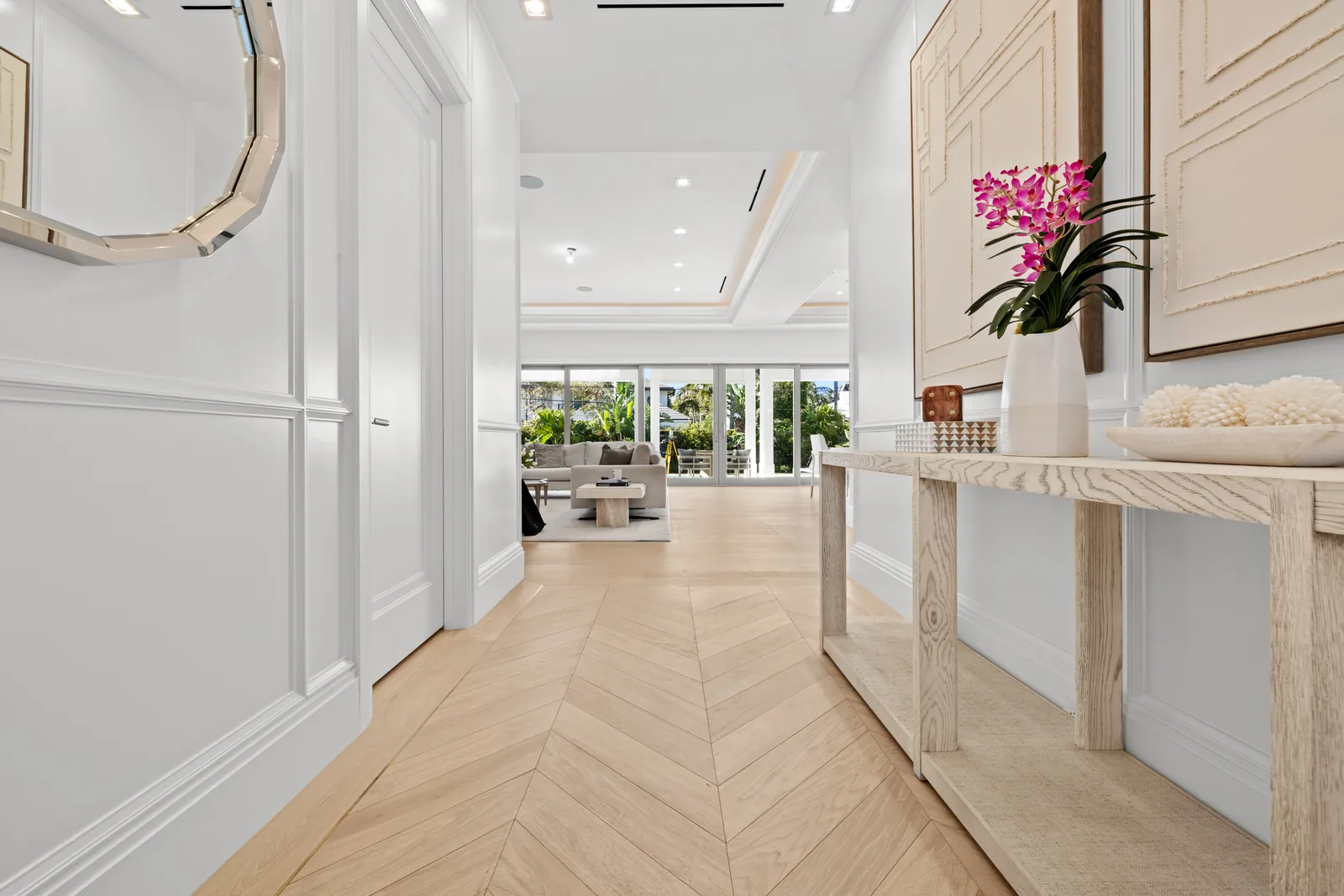
Riva Spain hardwood is slow-grown Spanish European oak — tighter grain, more even finish absorption, and dimensional stability that runs slightly better than standard European oak in the engineered format. We've installed Riva Spain into Houston projects since 2020 with the same 30-year structural / 25-year wear performance we'd expect from premium European oak in a stable climate. The dimensional stability advantage matters most on wide-plank installs (10"-12") and pattern flooring (Versailles, French herringbone) where any movement reads visually.
Riva Spain is the spec of choice for $5M+ Houston projects where the design intent justifies the premium spec. As Texas's only authorized distributor, we coordinate Riva install protocols specifically for the Gulf Coast climate.
Bottom line for builders and architects
Houston hardwood spec that consistently performs over 25 years:
- Engineered European oak — never solid on slab
- 5/8" or 3/4" thickness, 4mm wear layer minimum, baltic birch plywood core
- Glue-down installation with moisture-mitigation membrane
- Slab moisture below 4 lb/1000 sq ft CaCl2 or 75% RH probe
- HVAC at 35-55% RH for 14+ days before delivery, documented
- Acclimation 7-21 days depending on neighborhood microclimate
- Moisture readings logged at delivery, end of acclimation, and end of install
- Natural-oil or hard-wax oil finish (avoid high-gloss poly in humid climates — shows traffic faster)
Follow that profile and you'll have a Houston install that performs for two generations. Deviate from it and you'll be replacing the floor by year 5.
Related reading
Spec'ing a Houston project?
Trade-only pricing, named rep, full slab moisture protocol, and 30-year warranty stack — one conversation away.
Book a Trade Consultation →