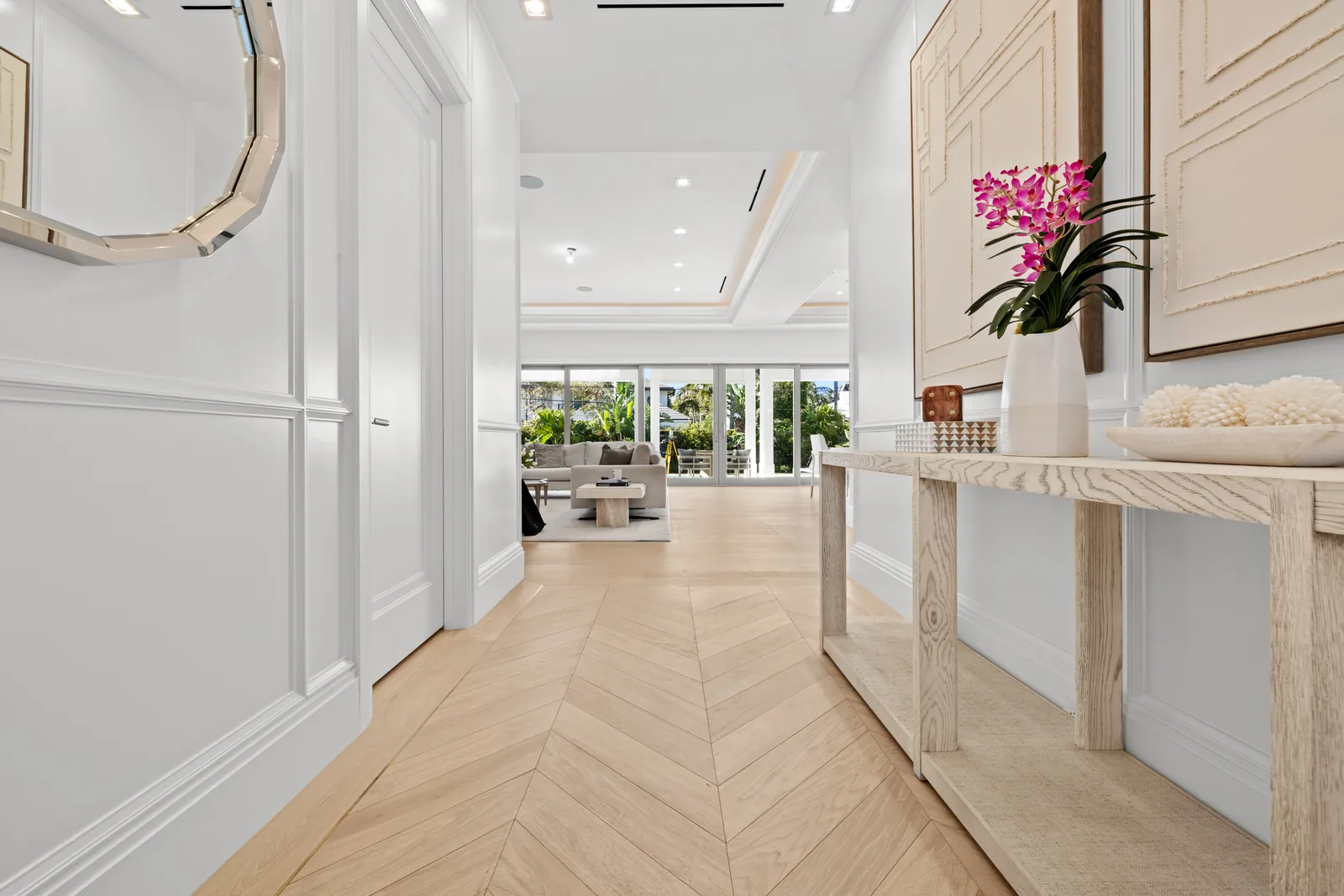
Engineered vs. solid hardwood for Houston slab-on-grade.
~70% of Houston new construction is slab-on-grade. The choice between engineered and solid hardwood determines whether the floor will warranty, last, and look right 10 years in. Trade-grade guidance for designers, builders, and architects.
TL;DR: For Houston slab-on-grade, engineered hardwood is the only manufacturer-warrantied spec. Multi-ply engineered construction handles slab moisture, slab movement, and Houston humidity swings dramatically better than solid wood. Solid hardwood still has a place — on pier-and-beam foundations with plywood subfloor — but specifying solid on slab is a warranty-voiding mistake that the floor will fail within 2-7 years.
The Houston slab-on-grade reality
Drive any Houston neighborhood built after 1990 — Memorial new-construction, Bellaire teardowns, West U infill, every Sugar Land subdivision — and you're looking at slab-on-grade construction. Concrete poured directly on grade with no crawl space, no basement, no air gap. It's the cheapest, fastest, and most-common Texas construction method, and it's a fundamentally different substrate than pier-and-beam.
The slab is the issue. Even when the concrete looks cured and the home is occupied with HVAC running, moisture is wicking up from the soil below at a measurable rate (MVER — moisture vapor emission rate). Industry standard MVER for hardwood install is <3 lbs/1000 sq ft / 24 hours. Houston slabs commonly test at 5-12 lbs without moisture barrier — well above the threshold that will buckle solid wood.
Why engineered hardwood handles slab; solid wood doesn't
Engineered hardwood is multi-ply construction: a thin layer (3-4mm) of premium hardwood (in our case European White Oak) bonded to a cross-grain plywood substrate (typically Baltic birch multi-ply). The cross-grain plies cancel out each other's expansion vectors — when one ply wants to expand width-wise, the perpendicular ply resists. Net result: dimensional stability dramatically better than solid wood.
Solid hardwood is just one piece of wood — all the grain runs the same direction. When moisture content rises, the board expands across the grain (width). When moisture drops, it contracts. In a humidity-stable environment, solid wood is fine. In Houston (40% RH winter → 75% RH summer, plus slab moisture below), solid wood expands until it buckles or cups, then contracts and leaves gaps.
What manufacturers actually warranty
Every major engineered hardwood manufacturer (including Riva Spain and Vandyck) warranties engineered for slab-on-grade installation, provided a moisture-mitigation primer is applied per spec. No major solid hardwood manufacturer warranties solid wood on slab — read the fine print on any solid wood spec sheet and you'll find a "subfloor must be plywood over crawl space, basement, or rated underlayment" clause.
Some installers will install solid hardwood on slab if a homeowner insists. The warranty is void from day one. We don't do this work — too many failed projects we'd have to triage on the back end.
Engineered vs solid — feature comparison
| Dimension | Engineered | Solid |
|---|---|---|
| Slab-on-grade install | Yes (with primer) | No — voids warranty |
| Pier-and-beam + plywood | Yes | Yes |
| Second-story plywood | Yes | Yes |
| Install methods | Glue-down, float, nail-down | Nail-down only |
| Install speed | Faster (large planks, glue-down) | Slower (nail per board) |
| Wide-plank stability | Excellent | Risky in wide widths |
| Humidity-swing tolerance | Excellent | Moderate |
| Refinishable | 2-3 times (4mm wear layer) | 5-7 times (full thickness) |
| Lifespan | 30-50 years | 50-100 years |
| Cost (material) | ~10-20% higher than solid | ~10-20% lower than engineered |
| Cost (install) | ~30-40% lower than solid | Higher (nail-down labor) |
When solid hardwood still makes sense in Houston
Solid wood isn't dead in Houston — it just has a narrower spec window.
Pier-and-beam historic homes
Pre-1960 Houston neighborhoods (Heights, Boulevard Oaks, Southampton, parts of River Oaks and Memorial) often sit on pier-and-beam foundations. Crawl space below, plywood subfloor above. Solid wood is fully appropriate here — and for period-correct restoration, sometimes preferred over engineered for character-grade matching.
Second-story additions over plywood
If you're adding a second story or doing a primary suite addition over a plywood deck, solid wood installs cleanly with nail-down on the plywood subfloor.
Heritage match for partial extensions
When extending an existing solid hardwood floor by 200-500 sq ft, matching to solid is usually easier than switching construction types within a continuous floor. We carry solid European White Oak and Vandyck character grade for these projects.
The install method differences
Engineered hardwood accepts three install methods, depending on substrate:
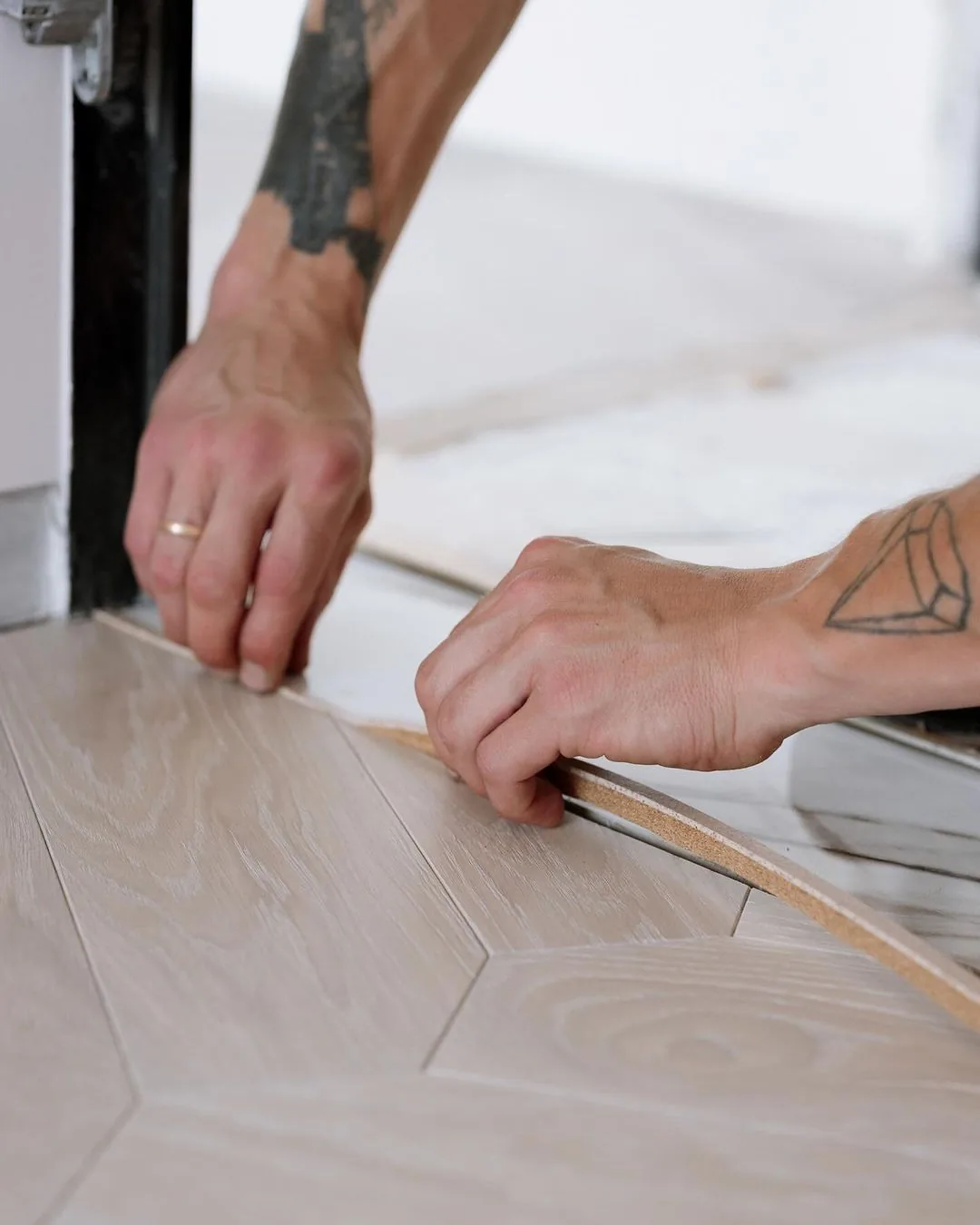
- Glue-down — slab-on-grade with moisture-mitigation primer; large-plank pattern installs (chevron, herringbone); fastest install, most-common Houston spec.
- Float — over engineered substrate or existing tile/vinyl with proper underlayment; quietest underfoot; remodel-friendly.
- Nail-down — plywood subfloor on raised foundation; classic install method.
Solid hardwood accepts one method: nail-down on plywood subfloor. That's it. Float and glue-down aren't manufacturer-warrantied for solid wood.
Moisture mitigation — the critical Houston detail
For any slab-on-grade install, moisture mitigation isn't optional. A liquid-applied moisture barrier primer (MAPEI Mapecem, Schluter Ditra-Heat, Sika MB-90 etc.) goes down first, before the adhesive. It seals the slab against vapor transmission, bringing MVER below the engineered manufacturer's threshold (~3 lbs/1000 sq ft / 24 hr).
Cost: roughly $0.50-0.80 per sq ft. Skip it on a Houston slab install and you'll have cupping or buckling within 2-5 years — and a voided warranty on top.
What about high-end "wide-plank solid" specs?
Some clients (and some designers) push for solid wide-plank — 8-12" wide solid white oak, sometimes reclaimed. The aesthetic is unbeatable. The Houston engineering reality is not. Wide-plank solid expands and contracts more in width than narrow-plank solid (more wood = more moisture absorption per board). In Houston humidity it's the worst-case combination: most moisture-sensitive material in the highest-humidity climate.
If a project absolutely demands wide-plank solid — heritage restoration, signature design call — it goes on pier-and-beam only, with humidity controls (whole-house humidifier set to 45-55% RH year-round, HVAC backup), and the client accepts that seasonal movement and gapping may occur. We document the engineering compromise in writing and have the client + designer sign off before order.
Our default Houston spec
Across 300+ Houston installations over the last three years, our default spec for slab-on-grade is: engineered European White Oak, 7-10 inch wide-plank, 4mm wear layer over Baltic birch substrate, glue-down with moisture-mitigation primer, hardwax oil finish. Riva Max Mercury (medium-cool gray-brown) is our most-spec'd color in this configuration.
For pier-and-beam, the default is the same engineered spec OR solid European White Oak in the same width range — designer call based on project context.
Related reading
- Hardwood Acclimation for Houston Humidity — the pillar guide on acclimation timing, moisture testing, and install windows
- Best Hardwood for Houston Humidity — material selection guide
- European White Oak vs American Oak in Houston Humidity
- European Oak Range
- Riva Max Mercury — most-spec'd Houston
- Hardwood Cost Transparency