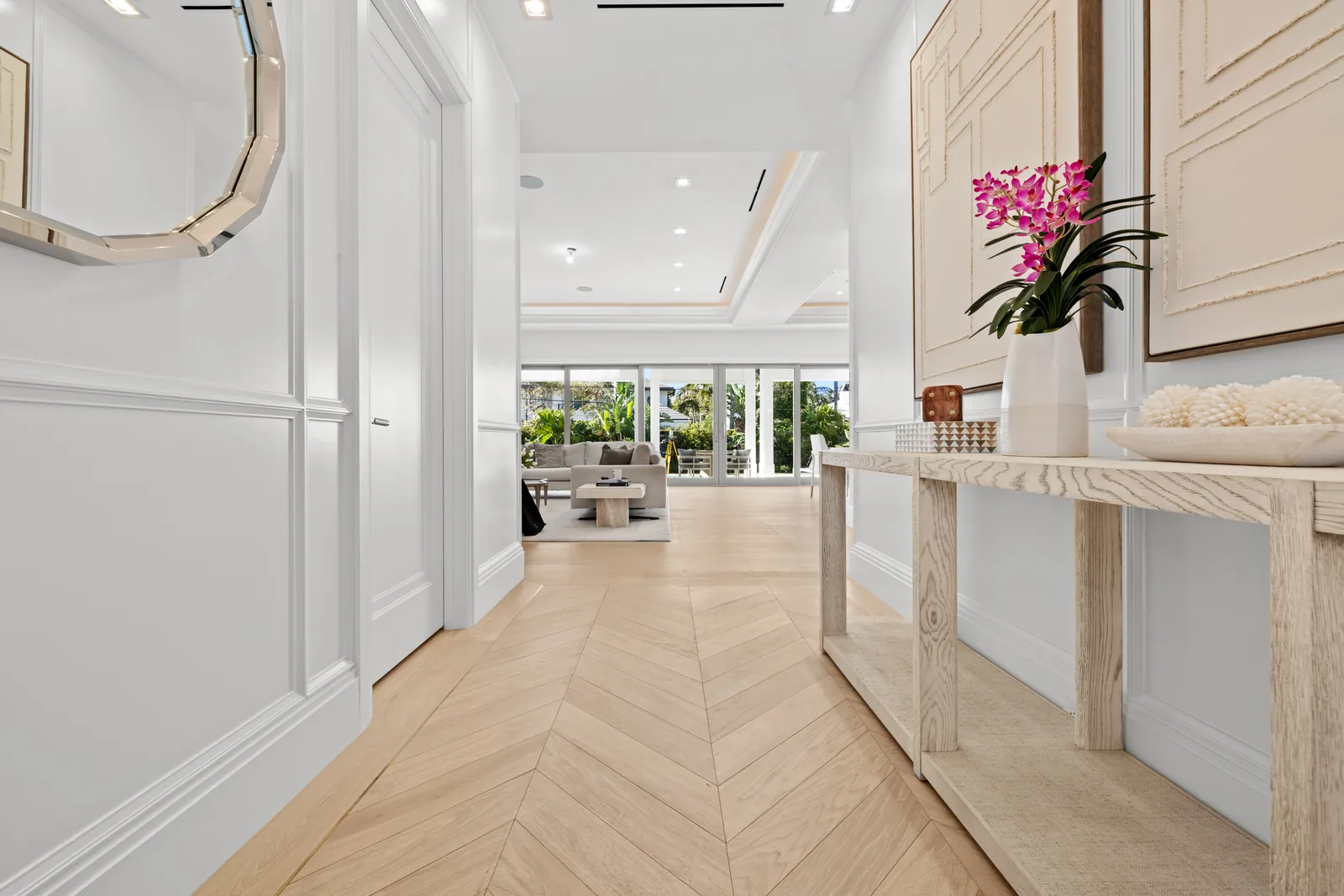
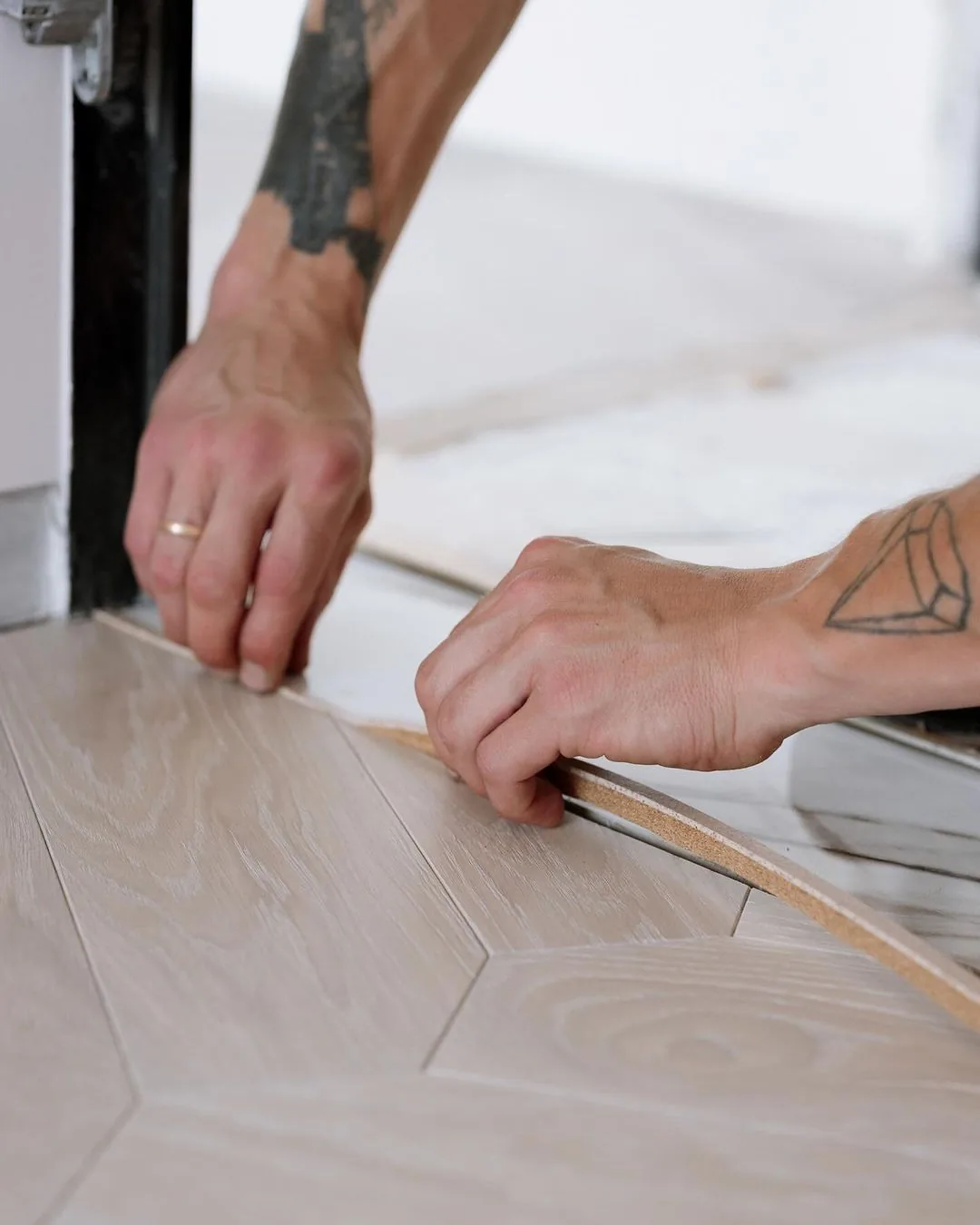
Herringbone vs chevron — two patterns, three variants, different rooms.
French herringbone, English herringbone, and chevron are the three pattern hardwoods Houston designers spec for foyers, dining rooms, and primary suites. They look similar at a glance and read completely differently in an interior. Here's the trade-spec breakdown.
TL;DR: Herringbone has square plank ends; chevron has 45° mitered ends. French herringbone interlocks the planks at 90° angles (creating a continuous interlocking weave); English herringbone alternates plank pairs at 90° (creating block transitions). Chevron creates a continuous V-pattern flow. Design intent: herringbone reads traditional + textured; chevron reads modern + architectural. Install: chevron tongue-and-groove tolerances are tighter; herringbone is more forgiving.
The three patterns — visual breakdown
French Herringbone
Square-ended planks installed at 90° to each other in an interlocking weave. Each plank's end butts against another plank's side, creating a continuous geometric pattern with no perpendicular break lines. The signature look of classic French parquet — refined, architectural, slightly more modern feel than English herringbone.
English Herringbone
Same square-ended planks, but installed in alternating pairs at 90° — each block of two planks forms a "V" that alternates direction. The pattern has visible block transitions and reads more traditional than French herringbone. The look of historic English country house floors and traditional American pattern installs.
Chevron
Mitered 45° plank ends create a continuous V-pattern flowing in one direction. No perpendicular interruptions — every plank end is cut at 45° so two planks meet to form a clean V. Reads modern, architectural, distinctly European. Often called "Hungarian point" or "Parisian chevron" in heritage contexts.
Side-by-side comparison
| Dimension | French Herringbone | English Herringbone | Chevron |
|---|---|---|---|
| Plank end cut | Square (90°) | Square (90°) | Mitered (45°) |
| Pattern direction | Continuous interlocking | Alternating blocks | Continuous V-flow |
| Design intent | Refined, transitional | Traditional, historic | Modern, architectural |
| Typical plank width | 4-6" | 4-5" | 4-7" |
| Install tolerance | Moderate | Most forgiving | Tightest (mitered cuts) |
| Material cost (per sq ft) | $20-28 | $18-26 | $22-32 |
| Install labor difficulty | Moderate | Moderate | High (precision miters) |
| Houston neighborhood fit | River Oaks, Memorial transitional | Heights traditional, Heritage | Memorial modern, EaDo, downtown |
How to pick — by room and design intent
Foyer
All three work for foyers. Choice depends on the rest of the house. French herringbone for transitional Houston interiors (most common pick). Chevron for modernist Memorial / downtown high-rise. English herringbone for Heights bungalow restorations and traditional River Oaks estates.
Dining room
Pattern hardwood reads beautifully in dining rooms — the long table sits visually anchored by the pattern beneath. French herringbone is the historic French dining floor; English for traditional American; chevron for modern dining. We supply more French herringbone than chevron for dining specifically.
Primary suite vestibule
Small spaces benefit from pattern. Chevron in a primary suite vestibule reads as architectural attention. Herringbone (either variant) reads as crafted. All three work; chevron is the more designer-forward call.
Whole-house pattern
Pattern hardwood as the whole-house floor (vs accent in foyer/dining) is a rarely-specified but possible move. French herringbone wholesale is the most successful — it scales without becoming visually overwhelming. English herringbone whole-house can feel busy at 3,000+ sq ft. Chevron whole-house works for very modern builds.
Install differences — what your crew needs to know
Subfloor flatness
All three pattern installs require subfloor flatness within 1/8" over 6 ft (vs straight-plank's 3/16" tolerance). Pattern installs amplify subfloor imperfections — a high spot that's invisible in straight plank becomes a visible offset in pattern. Sand or self-level the subfloor before pattern install.
Layout planning
Pattern installs start from the room's center, not the wall. Your installer marks the room's centerline and works outward symmetrically — last cuts go to the wall edges. Plan an extra day for layout vs straight-plank installs.
Tongue-and-groove tolerance
Chevron's mitered ends mean tighter T&G tolerances — each plank end must meet at exactly 45°, no field-cutting tolerance for adjustment. We supply factory-milled chevron from Riva Spain with tolerances tight enough that field-fitting isn't required. Herringbone is more forgiving — small field cuts work.
Pattern-trained crew
Standard hardwood installers may not have pattern experience. Verify your install crew is NWFA-pattern-trained or has documented pattern installs in their portfolio. Pattern installs are 40-60% slower than straight-plank — budget the schedule accordingly.
Cost comparison
Material-only pricing for European Oak in equivalent grade:
- Straight wide-plank: $13-20/sq ft (Riva Max baseline)
- English herringbone: $18-26/sq ft
- French herringbone: $20-28/sq ft
- Chevron: $22-32/sq ft
- Custom parquet (Versailles, Chantilly): $45-90+/sq ft — see custom parquet
Add 30-60% on install labor vs straight-plank to capture the pattern install complexity. See hardwood cost transparency for full pricing context.
When to NOT spec pattern
Pattern hardwood is a premium spec — both material and install. It's not the right call for every project.
- Tight budget projects — pattern adds 40-80% material cost + 30-60% install labor. If budget is the constraint, straight-plank wide-plank reads premium without the pattern premium.
- Open-plan great rooms — large open spaces sometimes feel "busy" with all-pattern floor. Use pattern in transition zones (foyer, dining, vestibule) and straight-plank in the main great room.
- Very low ceilings — strong floor patterns can make a low-ceiling room feel cramped. Test the pattern at scale before committing.
- Multi-family / commercial volume — pattern install slows the build schedule and adds crew complexity. Most multi-family developer specs are straight-plank for that reason.
Our Houston pattern installs
Across 300+ Houston installations, pattern hardwood has been roughly:
- French herringbone: 50% — most-specified pattern, used across most Houston neighborhood types
- Chevron: 30% — modern Memorial, Tanglewood, downtown high-rise
- English herringbone: 15% — Heights restoration, traditional Heritage, period-correct historic
- Custom parquet (Versailles, Chantilly, marquetry): 5% — heritage estate restoration, hospitality flagship, signature design
Related reading
- Chevron Hardwood Houston — full collection + install guide
- Herringbone Hardwood Houston — French + English variants
- Custom Parquet Houston — Versailles, Chantilly, marquetry
- Acclimation Guide
- European Oak Range
- Cost Transparency